Weight Loss Injection Side Effects: The Full Truth You Deserve to Know
Introduction:
Are you worried about weight loss injection side effects? You are not alone, this question is asked by thousands of people every single day. The honest answer is this: weight loss injection side effects are real, but most are mild, short-lived, and well-managed under a doctor’s guidance. Whether you are considering a GLP-1 injection like Ozempic or Wegovy, or exploring weight loss pills as an alternative, this guide explains what the science actually proves and why your doctor’s examination is the most important step before you begin.
1. What Is a Weight Loss Injection?
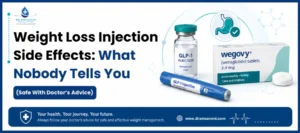
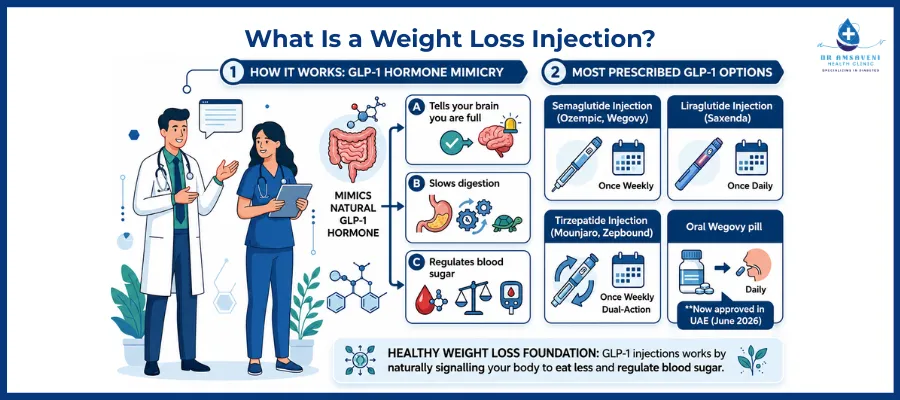
A weight loss injection is a prescription medicine injected under the skin typically once a week that works by mimicking the GLP-1 hormone naturally produced in your gut. This hormone tells your brain you are full, slows digestion, and regulates blood sugar. Weight loss pills like oral semaglutide work through the same mechanism swallowed daily instead of injected. The most prescribed GLP-1 injection options are:
- Semaglutide injection (Ozempic, Wegovy) once weekly
- Liraglutide injection (Saxenda) once daily
- Tirzepatide injection (Mounjaro, Zepbound) once weekly, dual-action
- Oral Wegovy pill once daily, now approved in UAE (June 2026)
Note: Healthy weight loss through a GLP-1 injection works by naturally signalling your body to eat less and regulate blood sugar the foundation of safe, sustainable weight management.
2. Weight Loss Injection Side Effects What Science Actually Says
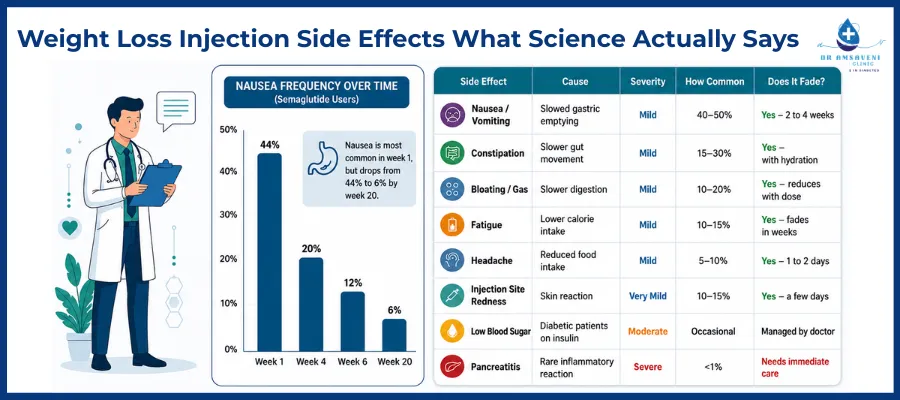
Weight loss injection side effects have been documented in large clinical trials involving thousands of patients. The majority are classified as mild-to-moderate and are caused by how the medicine slows digestion not by organ damage. A 2022 Diabetes Care study found that nausea was reported by 44% of semaglutide users in week one but only 6% still had it by week 20. The body adapts. Below is the complete reference table:
| Side Effect | Cause | Severity | How Common | Does It Fade? |
|---|---|---|---|---|
| Nausea / Vomiting | Slowed gastric emptying | Mild | 40–50% | Yes 2 to 4 weeks |
| Constipation | Slower gut movement | Mild | 15–30% | Yes with hydration |
| Bloating / Gas | Slower digestion | Mild | 10–20% | Yes reduces with dose |
| Fatigue | Lower calorie intake | Mild | 10–15% | Yes fades in weeks |
| Headache | Reduced food intake | Mild | 5–10% | Yes 1 to 2 days |
| Injection Site Redness | Skin reaction | Very Mild | 10–15% | Yes a few days |
| Low Blood Sugar | Diabetic patients on insulin | Moderate | Occasional | Managed by doctor |
| Pancreatitis | Rare inflammatory reaction | Severe | <1% | Needs immediate care |
Source: FDA prescribing information; NEJM STEP trials (2021); SELECT trial (2023); Diabetes Care (2022).
3. Weight Loss Pills Side Effects Same or Different?
Weight loss pills like oral Wegovy (semaglutide tablet) work through the identical GLP-1 pathway as the injection so weight loss pills’ side effects are largely the same: nausea, constipation, and occasional headaches. However, some patients find the pill causes slightly milder nausea because the dose absorbs more gradually. Both the injection and weight loss pills require a doctor’s prescription and proper medical supervision to be safe and effective.
4. Medication vs Diet for Weight Loss Which Works Better?
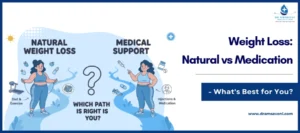
The comparison of medication vs diet for weight loss shows a clear pattern in clinical evidence. Diet alone achieves approximately 3–5% body weight reduction over one year. GLP-1 injection treatment achieves 10–15% over 68 weeks three times more. However, medication vs diet for weight loss is not an either-or question. Every GLP-1 programme is designed to work alongside a reduced-calorie diet, not instead of one. Healthy weight loss requires both.
5. Why a Doctor's Examination Is Non-Negotiable
A weight loss injection is not sold over the counter. It is a prescription medicine and the examination before prescribing is a full medical safety assessment, not a formality. Your doctor checks your BMI, blood sugar (HbA1c), kidney and liver function, current medications, and personal history of pancreatitis or thyroid conditions. After starting, dose is adjusted every four weeks, blood sugar is monitored, and any emerging weight loss injection side effects are managed proactively.
People who obtain these medicines without a prescription from online vendors or unregulated sources are not having their dose adjusted or their response monitored. This is why adverse effects are disproportionately reported among unsupervised users.
6. Who Should NOT Take a Weight Loss Injection?
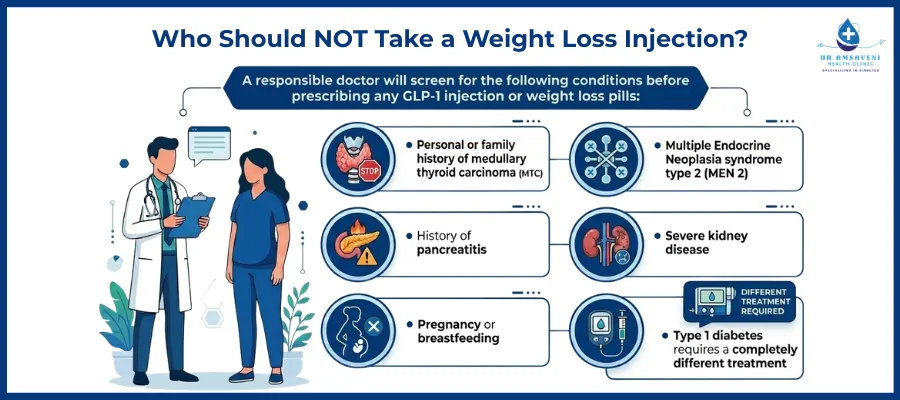
A responsible doctor will screen for the following conditions before prescribing any GLP-1 injection or weight loss pills:
- Personal or family history of medullary thyroid carcinoma (MTC)
- Multiple Endocrine Neoplasia syndrome type 2 (MEN 2)
- History of pancreatitis or severe kidney disease
- Pregnancy or breastfeeding
- Type 1 diabetes requires a completely different treatment
7. UAE Approves the Wegovy Pill What It Means for Patients
In June 2026, the Emirates Drug Establishment (EDE) officially approved oral Wegovy (semaglutide tablet) making the UAE only the second country in the world to approve this once-daily pill form. For patients in Dubai and Abu Dhabi, this means that both the weight loss injection and weight loss pills are now officially available locally without needing to travel abroad. The weight loss pills’ side effects for oral Wegovy are consistent with the injection form: mild nausea in the first few weeks, manageable under doctor supervision.
8. What You Should Do Today
- Do not purchase a weight loss injection or weight loss pills without a prescription
- Book a consultation with a qualified endocrinologist or metabolic health physician
- Share your complete medical history medications, surgeries, family history
- If already on the injection and experiencing side effects, do not stop ask your doctor about dose adjustment
- Ask your doctor about the new UAE-approved Wegovy pill it may suit your lifestyle better
Frequently Asked Questions
The most common weight loss injection side effects are nausea, constipation, bloating, fatigue, and headaches. Most are mild and fade within 2–4 weeks as the body adjusts to the GLP-1 medicine.
No. The vast majority of weight loss injection side effects are mild and temporary. Serious side effects like pancreatitis occur in fewer than 1% of patients and are screened for by your doctor before treatment begins.
For patients with a BMI above 30, GLP-1 injection medication achieves 10–15% weight loss versus 3–5% with diet alone. Medication is always used alongside a healthy diet not as a replacement.
Yes. Oral weight loss pills like Wegovy work through the same GLP-1 mechanism, so weight loss pills' side effects are similar to the injection, primarily mild nausea and constipation. Both require a doctor's prescription.
Yes. In June 2026, the UAE EDE approved the oral Wegovy (semaglutide pill) making UAE the second country globally to approve this form. The GLP-1 injection was already available in the UAE before this approval.