Introduction
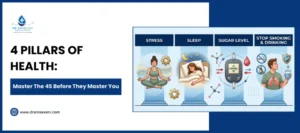
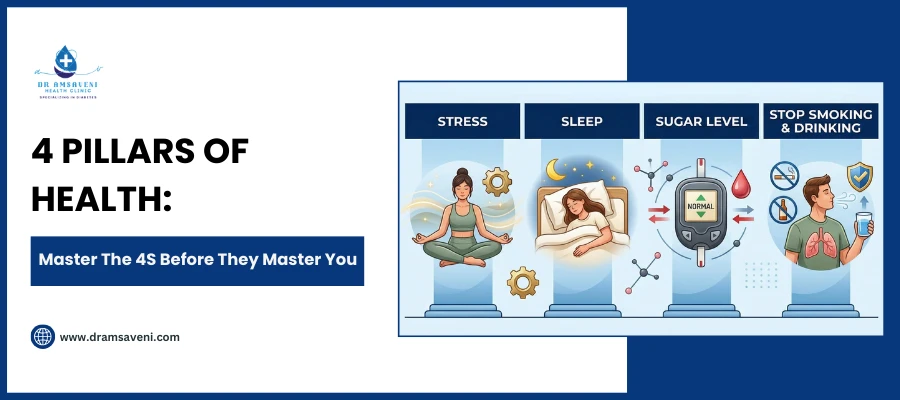
You eat well. You walk daily. Yet something still feels off, the energy is low, the blood pressure creeps up, the weight refuses to move. The problem is rarely what is on your plate. Most of the time, it is four things that nobody has ever sat you down and explained properly. These are the 4 pillars of health and together they are known as the 4S of healthy life: Stress, Sleep, Sugar Level, and Stop Smoking & Drinking.
Doctors see it every day. A patient with a clean diet and a regular routine walks in with high BP, early diabetes markers, and fatigue that no multivitamin can fix. The root cause, almost always, traces back to one or more of these four pillars being quietly ignored. Fix these four. And the body more often than anyone expects fixes itself.
The 4 Pillars of Health Explained
Stress Management is the first and most underestimated pillar. When stress becomes chronic, the hormone cortisol floods the body continuously. It raises blood sugar, increases blood pressure, deposits fat around the abdomen, and suppresses immunity. No amount of healthy eating compensates for a body permanently running on cortisol. Daily breathing practice, physical movement, and intentional rest are not optional; they are medical necessities.
Sleep Management is where the body does its most critical repair work. During deep sleep, insulin sensitivity resets, growth hormone is released, the immune system restocks, and the brain clears metabolic waste. Consistently sleeping less than 7 hours disrupts hunger hormones, spikes blood sugar, raises cardiovascular risk, and slows metabolism. Sleep is not laziness. It is maintenance and without it, every other health effort is compromised.
Sugar Level Management does not belong only to diabetics. Unsteady blood sugar affects everyone causing energy crashes, mood swings, weight gain, arterial damage, and kidney stress long before any diagnosis is made. The solution is not avoiding all carbohydrates. It is eating them intelligently with fibre, protein, and fat and moving the body after meals to use glucose before it accumulates in the blood.
Stop Smoking and Drinking is the fourth pillar, and perhaps the most straightforward cause yet the hardest in practice. Cigarettes constrict blood vessels, reduce oxygen delivery, and accelerate arterial ageing. Alcohol disrupts sleep architecture, destabilises blood sugar, burdens the liver, and amplifies stress hormones. Both habits quietly damage three of the other four pillars simultaneously.
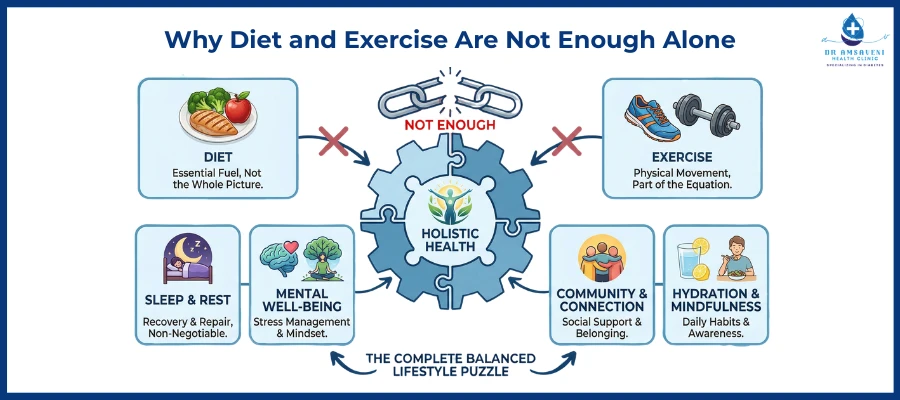
Why Diet and Exercise Are Not Enough Alone
This is the part that surprises most people. Nutrition and fitness matter enormously but they rest on a foundation. If that foundation is cracked by chronic stress, broken sleep, uncontrolled blood sugar, or daily toxins from smoking and drinking, the structure above it will always be unstable.
Address the 4S of healthy life, and the body responds. Blood pressure drops. Weight begins to move. Energy returns. Mood stabilises. Not because of a new diet but because the underlying chemistry has finally been corrected.These four pillars are not lifestyle tips. They are the root of 90% of the lifestyle diseases filling clinics today. Manage them, and most of those diseases simply do not arrive.
Frequently Asked Questions
4 Pillars of Health: Master the 4S Before They Ruin your Life and Health
The 4 pillars of health did not emerge from wellness culture. They emerged from a consistent clinical observation that the vast majority of patients presenting with preventable chronic conditions share a common upstream pattern. Not in their diet or their exercise habits, but in four specific lifestyle domains that standard medical consultations rarely have enough time to fully address. Lifestyle disease prevention, as a medical discipline, has long recognised that non-communicable diseases cardiovascular disease, type 2 diabetes, chronic kidney disease, fatty liver, hypertension share modifiable root causes. The 4S of healthy life framework identifies and organises those root causes into four actionable domains, making it one of the most practically useful structures in preventive medicine available today.
Stress Management The Chronic Disease Root Cause Nobody Gets Diagnosed With
How Cortisol Silently Rewrites Your Body's Chemistry Over Time
When stress becomes chronic, the hypothalamic-pituitary-adrenal axis the hormonal cascade governing threat response, remains in a state of sustained activation. Cortisol does not simply cause the subjective experience of feeling overwhelmed. It directly alters fat cell behaviour, promoting visceral fat storage around the organs. It modifies insulin receptor sensitivity, creating functional insulin resistance that manifests as rising blood glucose even in individuals who consume very little sugar. Most critical for lifestyle disease prevention, cortisol activates inflammatory signalling pathways that damage the inner lining of blood vessels, the endothelium. This damage accelerates plaque formation, stiffens arterial walls, and elevates blood pressure without any dietary cause being present. A patient can eat perfectly, exercise regularly, and still develop hypertension if stress management remains unaddressed. Stress is not a personality issue. It is a chronic disease root cause and it deserves to be treated with the same clinical seriousness as any measurable risk factor.
Sleep Management The Healthy Lifestyle Tip India Most Consistently Ignores
Why Cutting Sleep Is Cutting Years Off Your Life
In the context of healthy lifestyle tips for India specifically, sleep management occupies a uniquely neglected position. Late-night screen use, irregular sleep timing driven by family and social obligations, and a cultural tendency to view short sleep as a sign of productivity have created a population-wide sleep deficit with measurable metabolic consequences. Slow-wave sleep the deepest stage is the period during which insulin sensitivity is actively restored overnight. When this stage is shortened or fragmented, the body begins the following day with impaired glucose regulation regardless of what was eaten the night before. Simultaneously, the appetite-regulating hormones ghrelin and leptin are dysregulated, hunger increases, satiety signals weaken, and the body preferentially stores energy as abdominal fat. For anyone seeking genuine lifestyle disease prevention, sleep management is not optional. It is the physiological foundation on which every other healthy habit stands.
Sugar Management How to Avoid Diabetes Naturally Before It Begins
The Glucose Damage That Starts Long Before the Diagnosis
Understanding how to avoid diabetes naturally requires understanding that the damage pathway begins years before clinical thresholds are crossed. Post-meal glucose elevation even within ranges considered normal on standard fasting tests causes a process called glycation, in which glucose binds to proteins throughout the body and progressively alters their structure and function. Glycation of blood vessel walls reduces their elasticity. Glycation of kidney filtration membranes impairs their efficiency. Glycation of nerve proteins disrupts signal transmission. None of this is visible on routine blood panels. All of it is preventable through consistent, practical sugar management, eating carbohydrates alongside fibre and protein, moving after meals, maintaining consistent meal timing, and staying well hydrated. The most powerful natural strategy for how to avoid diabetes naturally is therefore not a supplement or a specific food, it is the daily management of the glucose curve through behaviour. Small, consistent corrections made before a diagnosis arrives are exponentially more effective than interventions made after one.
Stop Smoking and Drinking Blood Pressure Without Medicine Starts Here
How Removing These Two Habits Repairs What Medication Only Manages
For individuals seeking to manage blood pressure without medicine, stopping smoking and drinking is among the highest-impact available interventions and one of the most underutilised. Nicotine causes acute and sustained vasoconstriction, the narrowing of blood vessels that forces the heart to pump against increased resistance. Each cigarette raises blood pressure measurably within minutes. Over years of smoking, arterial walls stiffen and lose the elasticity required to buffer pressure fluctuations. This arterial ageing cannot be fully reversed by antihypertensive medication it can only be slowed and partially repaired by removing the cause. Alcohol raises blood pressure through a different but equally direct mechanism. It activates the sympathetic nervous system, increases cortisol output, disrupts overnight blood pressure dipping the natural overnight reduction in BP that protects the heart during sleep and causes rebound hypertension as it is metabolised. Regular drinkers who stop consistently see meaningful blood pressure reductions within two to four weeks, reductions comparable to those achieved by a single antihypertensive drug. Managing blood pressure without medicine is realistic for many individuals in early or moderate stages of hypertension but only when both smoking and drinking are genuinely removed, and only when the other three pillars of health are addressed simultaneously. Medication manages the number. The 4 pillars of health address the cause.
Why All Four Must Be Addressed Together
The Compounding Effect That Single-Pillar Thinking Always Misses
The clinical insight that separates the 4S of healthy life framework from generic wellness advice is the recognition that these four pillars do not operate independently. They form a reinforcing system and intervention in one pillar, while valuable, is consistently undermined when the remaining three continue generating the conditions that created the problem. Stress raises blood sugar. Elevated blood sugar disrupts sleep. Disrupted sleep amplifies stress. Smoking and drinking worsen all three simultaneously. The cycle is self-reinforcing and self-accelerating until it is interrupted at all four points at once. Lifestyle disease prevention, at its most effective, is therefore a simultaneous multi-pillar intervention. Not a sequence. Not a priority list. A parallel correction of all four foundations because the body does not wait for one pillar to be perfected before the others begin causing damage.